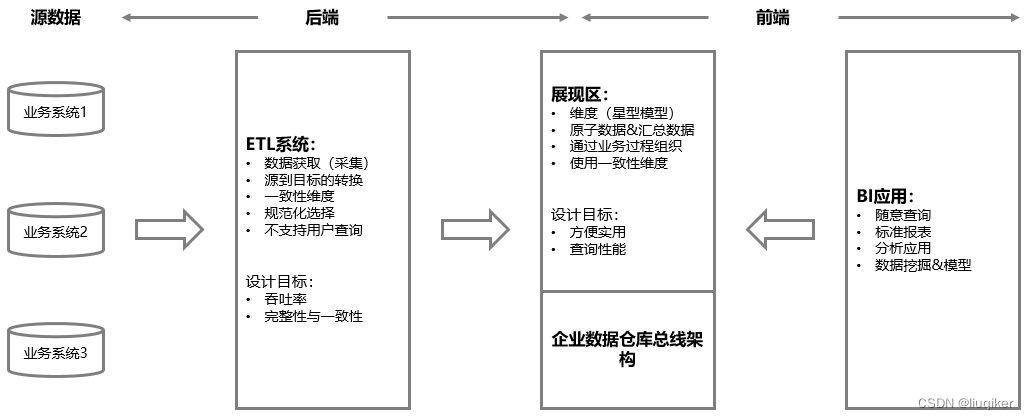
引言:DW,即Data Warehouse,数据仓库;BI,即Business Intelligence,商业智能。数据仓库存在的目的即为商业智能服务,二者相伴相生,故在此讨论DW/BI系统架构。
Kimball DW/BI架构的最后一个部件是商业智能(Business Intelligence)。在这里,BI指的是为用户提供利用展现区制定分析决策的能力。BI应用可以是简单的,仅作为专用的查询工具,也可以是复杂的,实现复杂的数据挖掘和数据分析的能力。
The
Kimball
Group Reader, Remastered Collection is the essential reference for data warehouse and business intelligence design, packed with best practices, design tips, and valuable insight from industry pioneer Ralph
Kimball
and the
Kimball
Group. This Remastered Collection represents decades of expert advice and mentoring in data warehousing and business intelligence, and is the final work to be published by the
Kimball
Group. Organized for quick navigation and easy reference, this book contains nearly 20 years of experience on more than 300 topics, all fully up-to-date and expanded with 65 new articles. The discussion covers the complete data warehouse/business intelligence lifecycle, including project planning, requirements gathering, system architecture, dimensional modeling, ETL, and business intelligence analytics, with each group of articles prefaced by original commentaries explaining their role in the overall
Kimball
Group methodology.
Data warehousing/business intelligence industry's current multi-
bi
llion dollar value is due in no small part to the contributions of Ralph
Kimball
and the
Kimball
Group. Their publications are the standards on which the industry is built, and nearly all data warehouse har
dw
are and software vendors have adopted their methods in one form or another. This book is a compendium of
Kimball
Group expertise, and an essential reference for anyone in the field.
Learn data warehousing and business intelligence from the field's pioneers
Get up to date on best practices and essential design tips
Gain valuable knowledge on every stage of the project lifecycle
Dig into the
Kimball
Group methodology with hands-on guidance
Ralph
Kimball
and the
Kimball
Group have continued to refine their methods and techniques based on thousands of hours of consulting and training. This Remastered Collection of The
Kimball
Group Reader represents their final body of knowledge, and is nothing less than a vital reference for anyone involved in the field.
Table of Contents
Chapter 1 The Reader at a Glance
Chapter 2 Before You Dive In
Chapter 3 Project/Program Planning
Chapter 4 Requirements Definition
Chapter 5 Data Architecture
Chapter 6 Dimensional Modeling Fundamentals
Chapter 7 Dimensional Modeling Tasks and Responsi
bi
lities
Chapter 8 Fact Table Core Concepts
Chapter 9 Dimension Table Core Concepts
Chapter 10 More Dimension Patterns and Considerations
Chapter 11 Back Room ETL and Data Quality
Chapter 12 Technical Architecture Considerations
Chapter 13 Front Room Business Intelligence Applications
Chapter 14 Maintenance and Growth Considerations
Chapter 15 Final Thoughts
DW
/
BI
系统组成分为四个:操作型原系统、ETL系统、数据展现、商业智能
一、操作型源系统
记录的是业务数据,认为原系统处于
数据仓库
之外,因为我们几乎不能才做这部分数据,它的目的是保留源数据的格式和内容。主要关注处理性能和可用性。
二、ETL系统
获取、转换、加载(Extract Transformation and Load,ETL)系统。其中包括工作区间、实例化数据结构、过程集合。是处于操作型源系统和
DW
/
BI
展现系统之间的区域。
数据操作流程
The
Kimball
Group Reader: Relentlessly Practical Tools for Data Warehousing and Business Intelligence Remastered Collection
The final edition of the incomparable data warehousing and business intelligence reference, updated and expanded
The
Kimball
Group Reader, Remastered Collection is the essential reference for data warehouse and business intelligence design, packed with best practices, design tips, and valuable insight from industry pioneer Ralph
Kimball
and the
Kimball
Group. This Remastered Collection represents decades of expert advice and mentoring in data warehousing and business intelligence, and is the final work to be published by the
Kimball
Group. Organized for quick navigation and easy reference, this book contains nearly 20 years of experience on more than 300 topics, all fully up-to-date and expanded with 65 new articles. The discussion covers the complete data warehouse/business intelligence lifecycle, including project planning, requirements gathering, system architecture, dimensional modeling, ETL, and business intelligence analytics, with each group of articles prefaced by original commentaries explaining their role in the overall
Kimball
Group methodology.
Data warehousing/business intelligence industry's current multi-
bi
llion dollar value is due in no small part to the contributions of Ralph
Kimball
and the
Kimball
Group. Their publications are the standards on which the industry is built, and nearly all data warehouse har
dw
are and software vendors have adopted their methods in one form or another. This book is a compendium of
Kimball
Group expertise, and an essential reference for anyone in the field.
Learn data warehousing and business intelligence from the field's pioneers
Get up to date on best practices and essential design tips
Gain valuable knowledge on every stage of the project lifecycle
Dig into the
Kimball
Group methodology with hands-on guidance
Ralph
Kimball
and the
Kimball
Group have continued to refine their methods and techniques based on thousands of hours of consulting and training. This Remastered Collection of The
Kimball
Group Reader represents their final body of knowledge, and is nothing less than a vital reference for anyone involved in the field.
Table of Contents
Chapter 1 The Reader at a Glance
Chapter 2 Before You Dive In
Chapter 3 Project/Program Planning
Chapter 4 Requirements Definition
Chapter 5 Data Architecture
Chapter 6 Dimensional Modeling Fundamentals
Chapter 7 Dimensional Modeling Tasks and Responsi
bi
lities
Chapter 8 Fact Table Core Concepts
Chapter 9 Dimension Table Core Concepts
Chapter 10 More Dimension Patterns and Considerations
Chapter 11 Back Room ETL and Data Quality
Chapter 12 Technical Architecture Considerations
Chapter 13 Front Room Business Intelligence Applications
Chapter 14 Maintenance and Growth Considerations
Chapter 15 Final Thoughts
随着公司业务的不断发展,公司会积累大量各种类型的数据。这些海量的数据如果没有得到有效的分析和利用,那么不会对业务产生该有的价值。构建一个大数据分析平台,结合多个业务系统,从中抽取海量数据进行管理、整合、分析和利用,从中发现潜在问题和有价值的规律,并通过可视化的方式进行展现,能够为管理层提供科学决策的支持,提升企业的业务能力和效益,确保数据驱动业务增长。
那么数据...
对于
数据仓库
体系结构的最佳问题,始终存在许多不同的看法,甚至有人把Inmon和
Kimball
之争称之为
数据仓库
界的“宗教战争”,那么本文就通过对两位提倡的
数据仓库
体系和市场流行的另一种体系做简单描述和比较,不是为了下定义那个好,那个不好,而是让初学者更明白两位
数据仓库
鼻祖对
数据仓库
体系的见解而已。首先,我们谈Inmon的企业信息化工厂。2000年5月,W.H.Inmon在DMReview杂志上发表一篇文章,里面写到一句话“……如果明天非得设计一个数据集市,我将不考虑使用其他的方法”;正是揭示了他的企业信息化工厂的特点。下图是关于他的企业信息化工厂的
架构
图:我们理解一下这个体系
架构
,左边是操作型
数据仓库
主要有四种
架构
,
Kimball
的
DW
/
BI
架构
、独立数据集市
架构
、辐射状企业信息工厂Inmon
架构
、混合Inmon与
Kimball
架构
。不过不管是那种
架构
,基本上都会使用到
维度建模
。
Kimball
的
DW
/
BI
架构
,可以参考这篇文章
数据仓库
(4)基于
维度建模
的
KimBall
架构
。
独立数据集市
架构
,采用这种
架构
的
数据仓库
,数据以部门为基础来部署,不考虑企业级别的信息共享和集成。也就是各个部门各自按照需要,各自在数据源同步数据,按照各自的标准,对数据进行处理。这种实际上就是没有
架构
,会造成分析数据的
1.1 传统数仓历史
1.1.1 5个时代
传统数仓发展史可以称为5个时代的经典论证战。按照两位
数据仓库
大师 Ralph kilmball、
Bi
ll Innmon 在
数据仓库
建设理念上碰撞阶段来作为小的分界线:
1970~1991
数据仓库
概念萌芽到全企业集成。
1991~199...
无需考虑企业级信息共享和集成,只针对部分人员的需求。适合快速响应
二、辐射状企业信息工厂Inmon
架构
辐射状企业信息工厂(Corporate Information Factory,CIF)方法。关注核心元素展开讨论。以部门为中心设计的,而不是以也业务中心
三、常见的
维度建模
错误理解
1.维度模型仅包含汇总数据 ×
Kimball
的
DW
/
BI
架构
    
Kimball
分工明确,资源占用更加合理,调用链路少,整个
DW
/
BI
系统更加稳定、高效、有保障。
    ETL系统高度关注数据质量、完整性、一致性。输入数据在进入时要检查其质量。一致的获取增值度量和属性的业务规则由ETL系统中的有技能的专业人员开发,这
1. 数据库技能:熟练掌握SQL语言,了解关系型数据库和NoSQL数据库的基本概念和使用场景。
2. 数据建模技能:能够设计
数据仓库
模型,包括维度模型和事实模型,并具备数据建模工具的使用经验。
3. ETL技能:能够使用ETL工具将数据从各种数据源中抽取、转换和加载到
数据仓库
中,并具备数据清洗和数据转换的技能。
4.
数据仓库
架构
:熟悉
数据仓库
的基本
架构
和常见的
数据仓库
架构
模式,如Inmon和
Kimball
等。
5. 数据质量管理:能够识别和处理数据质量问题,并实现数据质量监控和管理。
6. 数据可视化:熟悉数据可视化技术和工具,能够使用可视化工具展示数据分析结果。
7. 大数据技术:了解大数据技术和工具,如Hadoop、Spark等,能够使用它们处理大规模数据。
8. 数据安全和隐私:了解数据安全和隐私保护的相关法律法规和行业标准,能够设计和实现数据安全和隐私保护措施。
9. 项目管理技能:具备项目管理技能,能够协调和管理
数据仓库
开发项目的进度和质量。
此外,还需要具备良好的沟通能力、团队合作精神和自我学习能力,能够不断更新自己的技能和知识。
IDEA连接mysql又报错!Server returns invalid timezone. Go to ‘Advanced‘ tab and set ‘serverTimezone‘ prope
249461