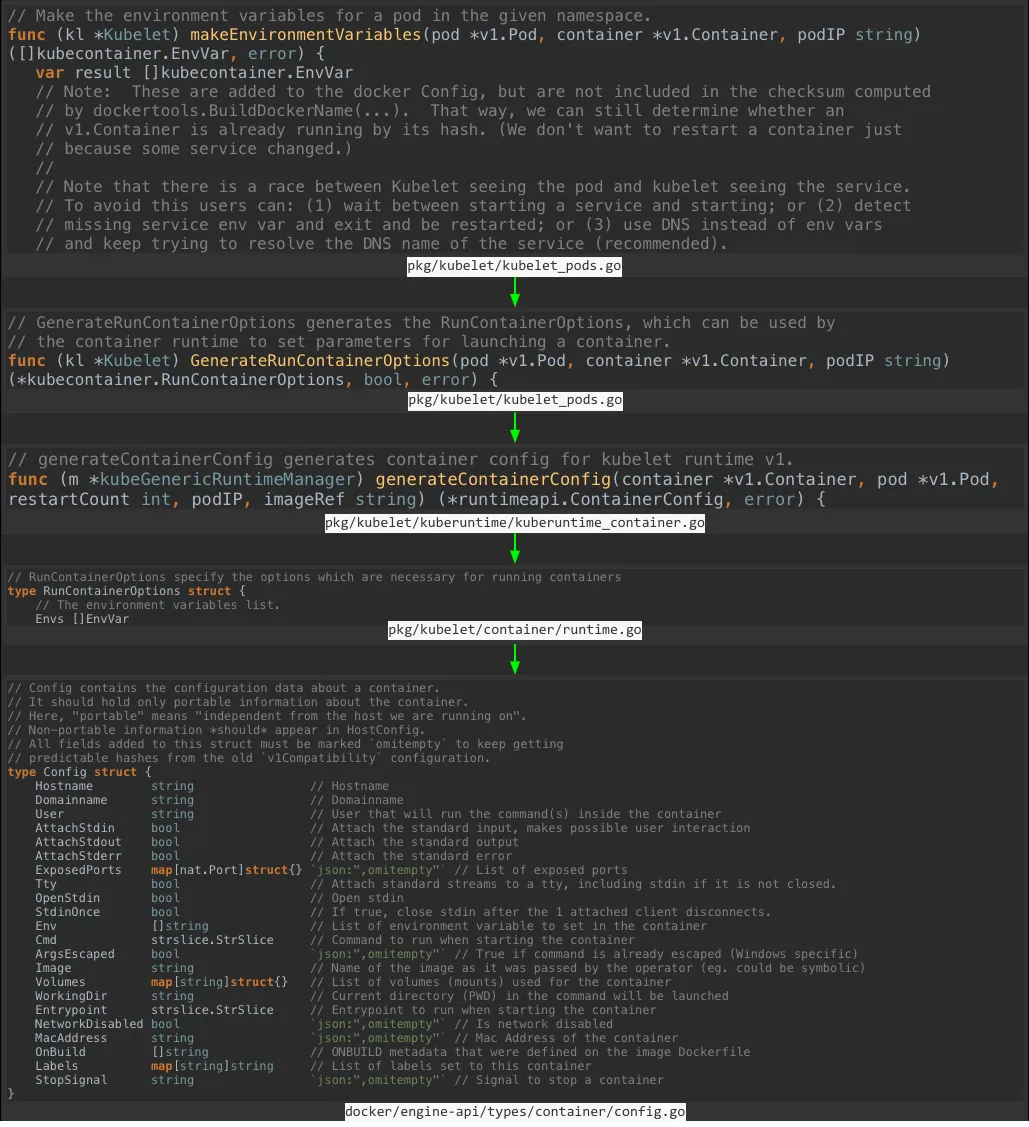
我们知道 Kubernetes 在启动 Pod 的时候为容器注入环境变量,这些环境变量将在该 Pod 所在的 namespace 中共享。但是既然使用这些环境变量就已经可以访问到对应的 service,那么获取应用的地址信息,究竟是使用变量呢?还是直接使用 DNS 解析来发现?下面我们从代码中来寻求答案。
// Config contains the configuration data about a container.// It should hold only portable information about the container.// Here, "portable" means "independent from the host we are running on".// Non-portable information *should* appear in HostConfig.// All fields added to this struct must be marked `omitempty` to keep getting// predictable hashes from the old `v1Compatibility` configuration.typeConfigstruct{Hostnamestring// HostnameDomainnamestring// DomainnameUserstring// User that will run the command(s) inside the containerEnv[]string// List of environment variable to set in the containerCmdstrslice.StrSlice// Command to run when starting the container
// RunContainerOptions specify the options which are necessary for running containerstypeRunContainerOptionsstruct{// The environment variables list.Envs[]EnvVar// The mounts for the containers.Mounts[]Mount// The host devices mapped into the containers.
Kubelet 向容器中注入环境变量的配置是在下面的方法中定义:
pkg/kubelet/kuberuntime/kuberuntime_container.go
// generateContainerConfig generates container config for kubelet runtime v1.func(m*kubeGenericRuntimeManager)generateContainerConfig(container*v1.Container,pod*v1.Pod,restartCountint,podIP,imageRefstring)(*runtimeapi.ContainerConfig,error){opts,_,err:=m.runtimeHelper.GenerateRunContainerOptions(pod,container,podIP)// set environment variablesenvs:=make([]*runtimeapi.KeyValue,len(opts.Envs))foridx:=rangeopts.Envs{e:=opts.Envs[idx]envs[idx]=&runtimeapi.KeyValue{Key:e.Name,Value:e.Value,config.Envs=envsreturnconfig,nil
// GenerateRunContainerOptions generates the RunContainerOptions, which can be used by// the container runtime to set parameters for launching a container.func(kl*Kubelet)GenerateRunContainerOptions(pod*v1.Pod,container*v1.Container,podIPstring)(*kubecontainer.RunContainerOptions,bool,error){opts:=&kubecontainer.RunContainerOptions{CgroupParent:cgroupParent}opts.Envs,err=kl.makeEnvironmentVariables(pod,container,podIP)returnopts,useClusterFirstPolicy,nil
// Make the environment variables for a pod in the given namespace.func(kl*Kubelet)makeEnvironmentVariables(pod*v1.Pod,container*v1.Container,podIPstring)([]kubecontainer.EnvVar,error){varresult[]kubecontainer.EnvVar// Note: These are added to the docker Config, but are not included in the checksum computed// by dockertools.BuildDockerName(...). That way, we can still determine whether an// v1.Container is already running by its hash. (We don't want to restart a container just// because some service changed.)// Note that there is a race between Kubelet seeing the pod and kubelet seeing the service.// To avoid this users can: (1) wait between starting a service and starting; or (2) detect// missing service env var and exit and be restarted; or (3) use DNS instead of env vars// and keep trying to resolve the DNS name of the service (recommended).
该代码段比较长,kubernetes 究竟如何将环境变量注入到 docker 容器中的奥秘就在这里,按图索骥到了这里,从代码注释中已经可以得出结论,使用 DNS 解析而不要使用环境变量来做服务发现,究竟为何这样做,改天我们再详细解读。